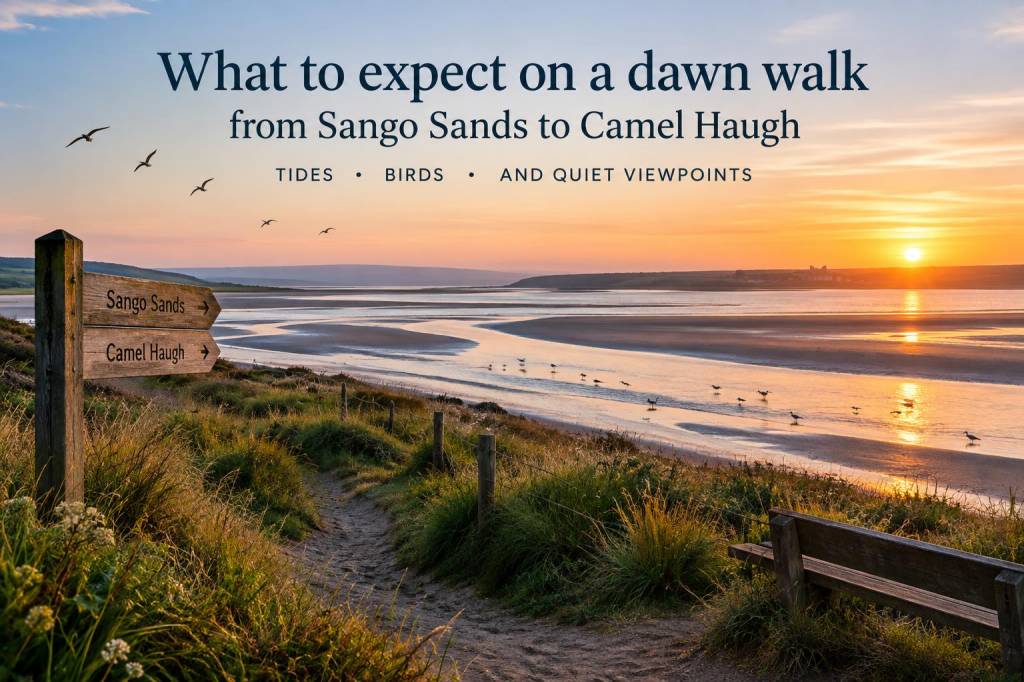
I have walked this stretch in near-darkness, when the dunes are only shapes and the sea is a low, steady presence beyond them. At dawn, the path from Sango Sands to Camel Haugh feels less like a simple coastal stroll and more like a quiet shift into another version of Durness, one where sound carries farther, birds seem louder, and every viewpoint arrives with a little extra stillness. If you are hoping for a walk that feels both local and spacious, this one gives you exactly that.
What makes this route special is not just the scenery, though the scenery is excellent. It is the rhythm of the morning. The light changes quickly, the tide sets the tone, and the bird life is often at its most active before the day fully wakes. I always feel that this is the hour when the coast reveals itself without performance. There are no crowds, no rush, and no need to keep moving unless you want to. You can pause, listen, and let the land and sea do most of the work.
What the walk feels like at first light
I usually start with a layered jacket, a hat, and gloves even in milder months, because the first minutes after sunrise can feel much colder than expected. The air comes off the Atlantic with a salt sharpness that wakes you quickly. Sango Sands, before the day gets busy, has a wide-open quality that I love. The beach and surrounding dunes hold the pale blue of early morning beautifully, and the whole area seems to soften under the first light.
The walk itself is not about speed. I take it slowly, partly because the ground can be uneven in places and partly because dawn rewards patience. You may find yourself stopping often: once for the changing colour of the sky, once for a distant shape in the sea, once because a bird has landed very close and you do not want to miss the moment. That is exactly how this route should be done.
Near the start, I like to look back toward the widening light over the sands. The beach can appear almost silver in the right conditions, and the shadows in the dunes add depth that is easy to miss later in the day. If you reach the route while mist is still hanging low, the scene can feel almost suspended.
Tides matter more than many visitors expect
If you only take one practical thing from me, let it be this: check the tide before you set out. Along this coast, tides shape not only what you see but also how you move through the landscape. Some stretches look straightforward at low water and far less welcoming at a higher tide, especially if you want to linger near the shoreline or explore a little beyond the main track.
I always check a local tide table before I leave, and I recommend doing the same. A dawn walk can be magical, but it is much more enjoyable when you know whether the sea is pushing in or pulling away. If the tide is low, you may get broader access to sandy sections and more room to pause near the water. If it is high, stay mindful of the shoreline and keep to safer, higher ground where needed.
Wind direction also changes the experience. A strong onshore wind can make the sea feel louder and the sand more active underfoot, while calmer conditions give you cleaner reflections and better birdwatching. On still mornings, I sometimes hear nothing but my own footsteps, the hush of the surf, and the calls of birds waking along the coast.
| Morning condition | What I notice | Walking note |
|---|---|---|
| Low tide | Wider sand, more shoreline detail, easier bird activity near pools | Gives more space for slow exploration |
| High tide | Sea feels closer, route can feel narrower in exposed sections | Stay alert near the water’s edge |
| Calm dawn | Soft reflections, clearer sound, better viewing conditions | Ideal for photography and quiet pauses |
| Windy dawn | More dramatic waves, more movement in grasses and dunes | Dress warmly and secure loose items |
Birds you are likely to notice
One of the pleasures of this walk is the way bird life reveals itself gradually. At dawn, birds seem less cautious, and their calls make the whole coast feel awake. I have often seen waders working the edge of the surf, darting in and out with quick, precise movements. Gulls are usually present, of course, but what I remember most are the smaller, quieter moments: a bird feeding in a shallow pool, a pair moving together along the wet sand, or a sudden lift of wings as they catch the morning wind.
Depending on the season, you may also notice seabirds further out, riding the air above the water or circling near rocky sections of the coast. I always bring binoculars if I can, because even a short walk becomes richer when you can study movement from a distance without disturbing anything. This is especially true at dawn, when the light is good but still soft enough not to spook wildlife too quickly.
What I enjoy most is that birdwatching here never feels separate from the walk itself. It is woven into it. You are not standing in one special place waiting for a sighting; you are moving through a living coastline where every bend, dune crest, and open patch of sand can offer something new.
Quiet viewpoints worth slowing down for
There are several moments on this route where I naturally stop without planning to. Some viewpoints are obvious, while others only reveal themselves when you are willing to pause and look a little longer. I like that about this walk. It does not force spectacle; it lets views arrive in layers.
From one rise in the dunes, the coastline opens in a wide sweep that gives the sea an almost endless feel. Elsewhere, the view narrows and becomes more intimate, with the framing grasses, the curve of the beach, and the changing light making the scene feel private. At dawn, these smaller viewpoints can be even more memorable than the grand panoramas, because the light falls gently across them and the absence of other walkers makes everything feel personal.
If you are carrying a camera, this is the kind of route where I would recommend shooting more than just the obvious landscape. Try low angles near the dune grass, reflections in shallow water, or the contrast between dark foreground shapes and the brightening sky. The best images on this walk often come from patience rather than distance.
What I carry with me
For a dawn walk on this coast, I keep my kit simple but deliberate. I want enough to stay warm, dry, and safe, without overpacking and making the walk feel cumbersome. A small rucksack usually does the job.
- A warm layer and a waterproof outer layer
- Gloves and a hat, even outside winter
- Water and a small snack
- Binoculars for birdwatching
- A phone or GPS device with battery charge
- A torch or headlamp for the darker part of the start
- A camera if I am planning to photograph the light
- A printed or downloaded tide check before I leave
I also wear footwear that can handle sand, damp ground, and uneven patches. A good pair of trail shoes or light boots is usually enough, but I would not choose anything delicate or slippery. Morning dew can make grass and dune paths wetter than they look.
Why dawn changes the whole experience
I have done coastal walks at midday, in bright afternoon sun, and under heavy evening cloud, but dawn remains my favourite time for this route. The difference is not only visual, although the colours are reason enough. It is also emotional. At dawn, the coast feels less like a place I am passing through and more like a place I am being allowed to witness.
There is a privacy to it. You notice your own breathing more. You hear the small sounds. You become aware of how the land shifts from darkness to light in stages rather than all at once. On a walk like this, that transition is part of the attraction. The route becomes a sequence of small reveals: first the outline of the shore, then the silver edge of the water, then the first bird calls, then the full shape of the morning.
That is also why I think this walk suits both careful solo walkers and quiet pairs of travellers. It is social only if you want it to be. Otherwise, it gives you room to think, observe, and move at your own pace.
Small things I notice every time
Even after repeat visits, I still find details that keep the walk fresh. A new pattern in the sand after a windy night. A patch of light sitting on the water in a way I have not seen before. The smell of the sea changing as the sun strengthens. Sometimes I notice rabbit tracks near the dune edge, or the delicate movement of grasses before the wind reaches my face. These details are not dramatic, but they are exactly what make a morning on this coast feel alive.
I also notice how silence behaves here. It is never complete silence; there is always the surf, the birds, the wind, some distant human sound if the morning is busy enough. But there is enough calm to let the coast feel unhurried. That is the feeling I come back for.
When I plan this walk, I try to leave myself enough time not just to go from one point to another, but to stand still for a while in between. The route is at its best when you give it room to unfold, because the tides, the birds, and the viewpoints are not separate features. They are all part of the same early morning conversation between land, sea, and light.