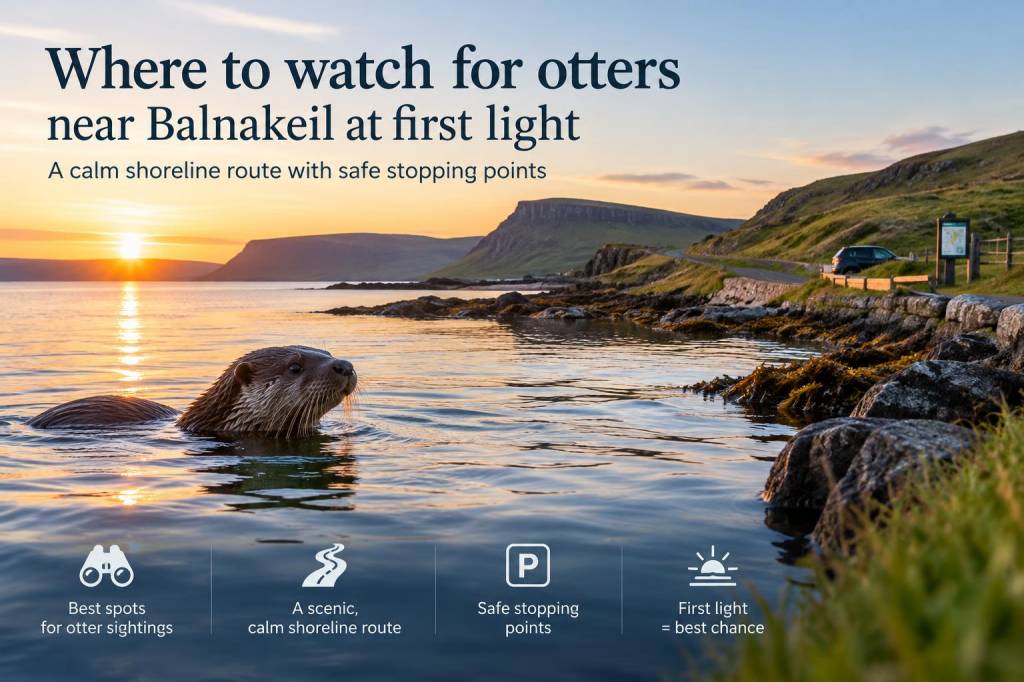
I like arriving near Balnakeil before most people are awake, when the air still feels almost silver and the shoreline is quiet enough to hear every ripple. If you want a chance to look for otters at first light, this is one of the most rewarding places I know. It is not a guarantee, of course—wildlife never works on our schedule—but a calm, patient walk along the right stretches of coast can make the difference between a brief glimpse and a memorable encounter.
What draws me back here is the mix of shelter, food, and low disturbance. Otters need places where they can move with ease between seaweed beds, tidal edges, and freshwater streams, and the coast near Balnakeil offers that kind of varied habitat. I also appreciate that there are sensible places to pause without crowding the shoreline, which matters if you want to watch respectfully and avoid disturbing anything that lives there.
Why early light matters so much
First light is special because the shoreline is often at its quietest. Bird activity is just beginning, dog walkers have not yet filled the path, and the water can be glassy enough to reveal quick movements near kelp beds. Otters often travel and feed when conditions feel safest for them, and low human activity helps. I have had my best sightings when I arrived just before sunrise and stayed still long enough for the coast to reveal its rhythm.
That said, I never treat an otter search like a chase. I slow down, scan likely feeding edges, and listen as much as I look. Sometimes I spot a rounded head breaking the surface. Other times I notice a small wake moving along the edge of a reef before I see the animal itself. Patience matters more than speed, and that mindset makes the outing far more enjoyable.
A calm shoreline route I trust
For a quiet morning, I prefer a gentle shoreline section near Balnakeil where access is straightforward and stopping does not interfere with movement along the coast. I look for stretches with broad views over the water, then keep walking slowly until I find a place where I can stand back from the edge without blocking the path. If the tide is suitable, I will linger near seaweed-rich shallows and rocky margins, since those places often draw feeding otters.
I keep my route simple: arrive early, take a careful look from a higher vantage point first, then descend only where the ground is firm and safe. I avoid stepping onto unstable rocks or slippery seaweed-covered surfaces. If the light is still dim, I let my eyes adjust before I move farther along the shore. That small pause often helps me notice subtle signs such as fresh tracks in sand, drips on stones, or disturbed water.
Safe stopping points I prefer
When I am out at first light, I think in terms of places where I can stop without crowding wildlife or putting myself in a poor position. I want firm footing, a clear view, and enough distance to observe quietly. The most useful stopping points are often not the most dramatic ones; they are the spots where I can wait calmly and let the coast do the work.
- Raised ground above the shoreline, where I can scan the water without stepping close to the edge
- Wide beach access points, where I can stand off to one side and avoid crossing active feeding areas
- Rocky viewpoints with secure footing, provided the surface is dry and stable
- Freshwater outflows, observed from a respectful distance, since these can attract movement
- Quiet bends in the coast, where visibility improves and foot traffic is usually light
I do not linger right beside a likely holt, den entrance, or narrow crossing point. If I suspect I am near a resting area, I move on. A successful wildlife outing should leave the animal exactly as I found it: unbothered, undisturbed, and able to carry on naturally.
What I look for before I even see an otter
One of the things I have learned from spending time in this part of Scotland is that otter watching starts long before the animal appears. I scan for clues. A sudden line of bubbles in calm water can be a sign. So can gulls or other birds shifting their attention to one spot. Fresh fish remains, tracks in soft sand, and narrow slides down a bank may also tell me I am in a promising area.
I also pay attention to the sea state. Gentle swell is often easier to watch than rough water, because the surface reveals movement more clearly. Wind direction matters too. If the breeze is too strong, it can blur sound and make it harder to spot ripples or low movement along the edge. I often find that a still, cool morning gives me my best chance.
How I watch without disturbing wildlife
My approach is simple: I stay quiet, keep distance, and never try to follow an otter once I have found one. I use binoculars if I have them, and I let the animal choose whether to remain visible. If it disappears into the water or slips behind rocks, I do not move closer just to force a better view. I wait, or I leave.
I also avoid sudden gestures and loud conversation. Even at a good distance, a person can change an otter’s behaviour if they move too quickly or stand in the wrong place. The goal is not to get the closest possible view. The goal is to witness a natural moment. That is what makes the memory valuable.
If I am with someone else, I agree on a viewing spot before we start. That keeps us from wandering around separately and accidentally creating extra disturbance. I also keep dogs leashed and under control near the shoreline, since a dog can quickly turn a calm search into stress for wildlife.
What I pack for an early shoreline outing
Balnakeil mornings can feel colder than they look. Even in good weather, the air off the sea can cut through light clothing, and damp ground makes standing still less comfortable. I keep my kit compact but practical.
- Warm layers, including a windproof outer layer
- Waterproof footwear with good grip
- Binoculars for scanning without moving closer
- Headtorch for the walk in before sunrise
- Thermos flask with a warm drink for a longer wait
- Mobile phone fully charged in case conditions change
- Map or offline directions, especially if fog rolls in
I also bring a small bag for any litter I find. Remote places deserve the same care as busy ones, and a clean shoreline is part of what keeps wildlife returning.
Reading tide, light, and weather
Timing is everything on a coast like this. I like a falling or mid tide when there is enough exposed edge for viewing, but still enough water around rocks and channels for otters to travel through. A completely empty shore can be less productive, and a very high tide can hide too much of the feeding ground. I check conditions before I leave, then adjust my route if the tide or wind looks unhelpful.
Light is another factor. Low sun can help by throwing texture across the water, but harsh glare can make spotting difficult if I am looking into it. I try to position myself with the light at an angle, not straight in my face. If there is mist, I am patient. Sometimes a soft haze actually makes the scene feel more alive, even if visibility drops a little.
Weather can also shift quickly near the coast. A morning that starts calm may turn wet or windy before I am done, so I do not overcommit to a long exposed section if the forecast looks unstable. Comfort matters because if I am cold, distracted, or in a hurry, I will miss more than I see.
Signs that make me think I am in a good otter area
| Sign | What I notice | What it can mean |
|---|---|---|
| Seaweed beds | Dense kelp and sheltered water | Likely feeding habitat |
| Fresh tracks | Small prints in sand or mud | Recent movement through the area |
| Low wakes | Thin ripples crossing calm water | An animal moving just below the surface |
| Bird attention | Gulls or other birds focusing on one patch | Possible feeding activity nearby |
| Quiet shoreline edges | Little human disturbance | Better chance of natural behaviour |
What I tell people who ask me for a first-light plan
I tell them to arrive earlier than they think they need to, because the best moments often happen before the sky brightens fully. I suggest walking slowly, stopping often, and choosing one or two safe viewpoints rather than racing from place to place. I also remind them that a good otter outing is measured in awareness, not in sightings alone. Even if nothing appears, the light, the sound of the shore, and the sense of stillness are worth the effort.
Most importantly, I encourage people to let the coast remain wild. If an otter appears, enjoy it from a respectful distance. If it does not, take that as part of the experience rather than a failure. Near Balnakeil, I have learned that patience and restraint are usually rewarded, sometimes with a fleeting shape in the water, sometimes with a broader appreciation of the place itself.