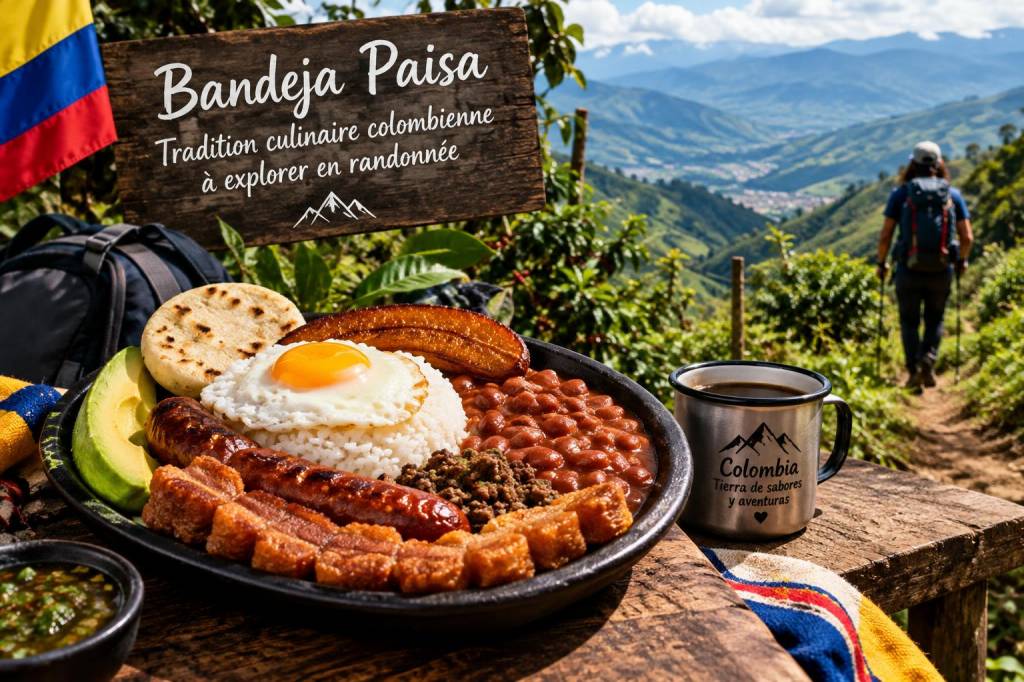
When I think about long mountain days, I often think about food that earns its place in a pack as much as on a plate. That is why Bandeja paisa feels so compelling to me: it is not just a meal, but a cultural marker, a calorie-dense reward, and a window into Colombia’s regional identity. If I were planning a route through Andean country, I would absolutely make space for cuisine traditionnelle colombienne à explorer en randonnée, because it captures the exact meeting point between movement, landscape, and local flavor.
On a hiking trip, I look for food that tells me something real about the place I am crossing. In Colombia, especially in Antioquia and neighboring highland areas, bandeja paisa does that with unusual clarity. It reflects agricultural history, rural labor, family cooking, and a region that has long valued hearty sustenance. It also speaks to a broader South American trekking reality: many trails pass through communities where meals are practical first, ceremonial second, and unforgettable because of that order.
Why bandeja paisa matters on a hiking journey
I see bandeja paisa as a perfect example of hiking food with a story. It is generous, filling, and deeply local. At first glance, it can feel almost excessive for a single plate, but that is precisely the point. In the Colombian highlands, where long workdays and steep terrain shaped daily life, a substantial meal was not indulgence; it was survival and hospitality.
A classic serving often includes rice, red beans, ground meat, chicharrón, fried egg, plantain, avocado, chorizo, arepa, and sometimes morcilla. That combination delivers a remarkable spread of textures and energy. For a hiker, it also offers a useful lesson: local food systems are often optimized for the exact kind of exertion travelers seek out on foot.
- Carbohydrates from rice, beans, plantain, and arepa.
- Protein from meat, egg, chorizo, and beans.
- Fats from chicharrón and egg, useful for energy density.
- Fiber and micronutrients from beans, avocado, and plantain.
For someone traveling slowly, this is more than a restaurant order. It is a field lesson in how culture, labor, and terrain shape cuisine.
What bandeja paisa usually contains
I like breaking down the dish before I eat it, because each element has a role. When I understand that role, I enjoy the meal more fully and I can compare it to food traditions in other mountain regions.
| Component | Function | Hiking relevance |
|---|---|---|
| Rice | Base carbohydrate | Quick, reliable energy |
| Beans | Protein, fiber, minerals | Staying power on long days |
| Ground meat | Savory protein | Recovery support after exertion |
| Chicharrón | Crisp fat and flavor | Energy-dense, very satisfying after effort |
| Fried egg | Soft richness | Extra protein and calories |
| Avocado | Healthy fats | Satiety without heaviness |
| Plantain | Sweet starch | Balances the savory elements |
| Arepa | Corn accompaniment | Portable tradition, easy to share |
I would not treat it like trail fuel in the strict backpacking sense, because it is usually too large and rich for mid-hike digestion. Instead, I see it as an ideal post-hike meal or a substantial lunch on a rest day after a demanding route.
How I compare it with other South American hiking foods
When I travel in mountain regions, I often notice that food falls into two categories: food meant to keep people moving, and food meant to restore them after moving. Bandeja paisa sits firmly in the second category, but it still connects to a wider hiking culture across the continent.
In Peru, a trekker might encounter quinoa soups, potato dishes, or cancha. In Bolivia, mountain meals often lean on potatoes, corn, and meats that can be prepared simply at altitude. In northern Argentina and Chile, I see empanadas, stews, and roasted meats that fit long travel days. Colombia’s signature is different because it is especially abundant, layered, and celebratory.
- Peru: lighter trekking meals, soups, and grains often dominate.
- Bolivia: high-altitude staples with strong reliance on potatoes and corn.
- Argentina: meat-forward meals, often portable or grill-based.
- Colombia: bandeja paisa stands out for volume, variety, and regional identity.
That contrast matters to me because it shows that hiking food is never just “fuel.” It is cultural memory, geography, and social habit on a plate.
Where I would look for it on a route
If I were planning a hiking itinerary in Colombia, I would pay close attention to towns, valleys, and urban edges where regional restaurants serve traditional food to workers, families, and travelers. Medellín is the obvious reference point, but the dish also appears widely in Antioquia and beyond. In rural areas, I would expect more variable versions, sometimes with smaller portions or slight substitutions depending on supply and local preference.
I also like the idea of using food stops as part of route planning. In mountain travel, I have learned that a great meal can anchor a day just as effectively as a viewpoint. A good lunch stop can become a cultural memory, especially if the setting is a village plaza, a roadside comedor, or a family-run kitchen where the server explains the ingredients with pride.
For travelers who care about local culture, that matters. A meal is not only about consumption. It is a chance to support local producers, ask respectful questions, and understand what people eat when they are not trying to impress visitors.
Practical considerations for hikers eating rich local food
I have made enough mountain-food mistakes to know that timing is everything. A heavy meal can be a joy after a long ascent, but it can also make the next climb unpleasant if eaten too late or in too large a portion. Bandeja paisa deserves respect for its richness.
- Eat it after the day’s hardest exertion, not before a steep climb.
- Share a plate if you still have several hours of hiking ahead.
- Balance it with water and, if possible, a lighter snack later.
- If you are sensitive to rich or fried foods, ask whether a smaller serving is available.
- Use it as a recovery meal, especially after a wet or cold trail day.
I also pay attention to how I feel at altitude. Heavy, salty meals can be comforting in cool weather, but they may feel overwhelming if I am already dehydrated. On long treks, I prefer to treat bandeja paisa as a destination meal rather than something I squeeze into the middle of an active day.
What the dish reveals about Colombian identity
I find bandeja paisa fascinating because it is both specific and symbolic. It belongs to a region, yet it has become one of the most recognizable Colombian dishes abroad. That popularity can be helpful, but it can also flatten nuance if people assume this one plate represents all of Colombia.
In reality, Colombia’s food culture is incredibly varied. Coastal dishes differ from Andean ones. Amazonian ingredients differ from highland staples. Caribbean cooking brings different spices, seafood, and preparation styles. So when I think about cuisine traditional to Colombia for hiking exploration, I do not treat bandeja paisa as a national summary. I treat it as a powerful regional expression that opens the door to deeper culinary discovery.
That nuance is important for responsible travel. If I only chase the famous dish, I miss the broader table. If I take the dish seriously as a regional anchor, I become more open to lesser-known foods and more likely to support local kitchens instead of tourist shortcuts.
Nutrition, portions, and energy on the trail
I like concrete numbers when I plan food around hiking, even if they are approximate. A full bandeja paisa can easily exceed 1,200 calories, and in some restaurant versions it can go well above 1,500 depending on portion size and preparation. That is a lot for one plate, but it also explains why it has such a strong reputation as a restorative meal.
For comparison, a long hiking day can burn anywhere from 2,500 to 5,500 calories depending on body size, elevation gain, pack weight, and duration. That means a substantial regional meal after the trail can make practical sense, especially if it helps a traveler recover before another outing. I would never recommend it as an ultralight trail snack, but I would absolutely recommend it as part of a culturally informed trekking itinerary.
What I appreciate most is the balance between everyday ingredients and feast-like presentation. It is not an artificial sports meal. It is real food from a real culinary tradition, and that authenticity is part of its value.
Sources I trust for deeper context
When I want to cross-check cultural and culinary details, I rely on a mix of food history, tourism, and institutional sources. These are useful starting points:
- Colombia Travel: regional food and travel context, including Antioquia cuisine.
- Encyclopedia Britannica: background on Colombian geography and cultural regions.
- FAO: agricultural context for beans, maize, plantain, and livestock systems in the region.
- University and museum publications on Colombian foodways and regional identity.
For travelers, I would also recommend consulting local tourism boards and restaurant associations for up-to-date opening hours, seasonal offerings, and regional specialties. On the ground, a conversation with a cook often teaches more than a menu ever could.
Questions I would expect readers to ask
Is bandeja paisa too heavy for hikers? For a mid-hike meal, usually yes. For a post-hike meal, it is excellent.
Is it always served the same way? No. Ingredient sets vary by household, restaurant, and town.
Is it vegetarian? Traditional versions are not, although some modern restaurants offer adaptations.
Does it represent all Colombian cuisine? No. It represents one strong regional tradition, which is exactly why it is worth exploring carefully.
Would I choose it on every hiking day? No, but I would absolutely build a route around it at least once if I were traveling through the Colombian Andes.