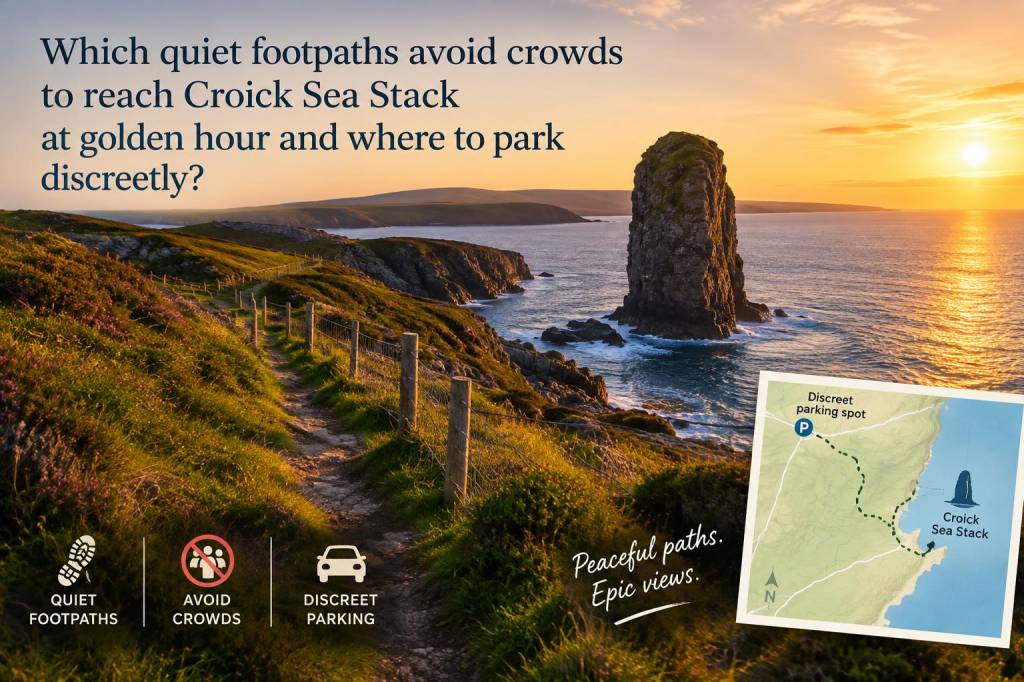
I picked the Croick sea stack for a reason: it’s one of those places that looks impossible until you find the quiet path that makes it all feel intimate. Golden hour there can turn the sandstone and waves into molten copper, and if you time it right and keep to respectful, little-used routes, you can have an almost private show. Below I share the footpaths I use to avoid crowds, where I park without spoiling the place, and practical tips for photography and safety so you can make the most of that fleeting light.
Getting there and the access mindset
First, a word on access: much of the coastline around Durness and the Croick area is covered by the Scottish outdoor access code, but there are working crofts, farm tracks and nesting seabird colonies to consider. I always follow signs, close gates behind me, avoid fenced croft land unless it’s a public right of way, and park where I’m not obstructing farm operations or local traffic. Being discreet is not about hiding—it’s about being small, respectful and leaving no trace so these spots stay peaceful for everyone.
Which quiet footpaths I recommend
There are three approaches I use depending on the tide, my mood and whether I’m walking with camera kit only or a full rucksack.
The North Shore path (my go-to for solitude) — Start from the small layby by the public bridleway off the A838, a few minutes’ drive from Durness village. The path follows low cliffs and croft boundaries and drops down along grassy terraces to a secluded bay beneath the stack. It’s rough underfoot in places (short heather, peaty turf) but almost never busy because it’s not on the main tourist map. Allow 20–40 minutes each way from the car depending on camera stops.The Old Croft Track (best when tides are high) — This is an old vehicle track used by crofters that becomes a clear footpath. Park politely at the small pullover near the stone bridge and follow the track past a couple of crofts. It’s slightly longer but offers higher vantage points and a broad sweep of the coast for panoramic golden-hour shots. I prefer this route when I want to capture the stack with a wider seascape and sky.The Beach Descent (for intimate, low-angle work) — If the tide is down and you want seabed reflections and foreground textures, take the steep grassy path down from the tiny car spot by the ruined wall (there’s usually space for 2–3 cars without blocking). The descent is short but steep; waterproof boots and a walking pole help. This route gets the most dramatic low-angle compositions at sunset but is simplest to time for return before darkness.All three routes avoid the busier main coastal walk that skirts the cliff edge and attracts day-trippers and dog walkers. I prefer paths that cut inland a little, following croft lines; they feel quieter and reduce cliff-edge footfall at sensitive nesting times.
Where to park—discreetly and responsibly
Finding a parking spot that’s both discreet and legal is about timing and local awareness.
Use the small pullover points — There are a few unmarked pullovers within a 5–10 minute walk of the footpaths I’ve described. They’re not official car parks but are tolerated when you leave room for farm vehicles, avoid blocking gateways and don’t linger in the daytime rush. I never park across a gate or on a verge that will churn to mud if rain comes.Village car park + short drive — If you prefer a formal space, park in Durness village and drive the extra few minutes to the trailheads. It adds a little walk but keeps parking pressure off croft roads.Arrive outside peak times — Early morning and just before sunset are best. Late afternoon parking near crofts can be sensitive if locals are returning home; I aim to arrive 45–60 minutes before golden hour and to be gone within 90 minutes after sunset.Never park on corners, over driveways or in front of gates. If you’re in a campervan, be mindful of your footprint—large vehicles draw attention and can block access.
Photography tips for golden hour at the stack
Golden hour can be two things: soft and pastel at dawn, or warm and punchy at sunset. Here’s how I shoot both.
Gear basics — A sturdy tripod, a wide-angle (16–35mm) for seascapes and a 70–200mm for stack detail are my staples. I carry a CPL filter for managing reflections and a 6–10 stop ND for long exposures when the light softens. Fast lenses (f/2.8) help for low-light hand-held shots but for golden-hour landscapes I’m almost always on a tripod.Compositions I favour — Work with foregrounds: tidal pools, kelp, and textured sand or pebbles create leading lines to the stack. Try placing the stack off-centre (rule of thirds) and use a low-angle to emphasise height. When the sun lights the face of the stack, back up and compress with a longer focal length to make the rock dominant against the sky.Exposure strategy — Golden hour can create high contrast. I bracket exposures for landscapes or use a graduated ND if the sky is much brighter. For seascapes I’ll often underexpose slightly to preserve highlights, then recover shadow detail in post.Be patient with the sea — Wait for the wave rhythm that complements your chosen shutter speed: 1/200–1/500s freezes spray, 0.5–2s smooths motion but retains texture, and 10–30s turns the water into glass for surreal reflections.Wildlife & seasonal notes
Spring and early summer bring nesting seabirds. I keep to the paths and avoid cliff edges where birds are breeding. Late autumn and winter offer dramatic skies and fewer people but colder winds—layer up and check weather forecasts; exposed coastlines change quickly.
Safety and kit checklist
| Item | Why I bring it |
| Waterproof jacket & layers | Coastal wind and spray—temperature changes fast |
| Sturdy boots | Muddy and uneven ground on paths and descents |
| Tripod | Essential for golden-hour long exposures |
| Headtorch | Returning after sunset or in low light |
| Phone with offline map | Spotty signal—use OS Maps or similar |
| Small first-aid kit | Minor cuts/scrapes on rough terrain |
I always tell myself that the best image is the one that didn’t disturb the place for its sake. Approach the Croick sea stack with a slow pace, a quiet footfall, and respect for those who live and work along the shore. Do that, and golden hour will reward you with light that feels like it was put there just for you.