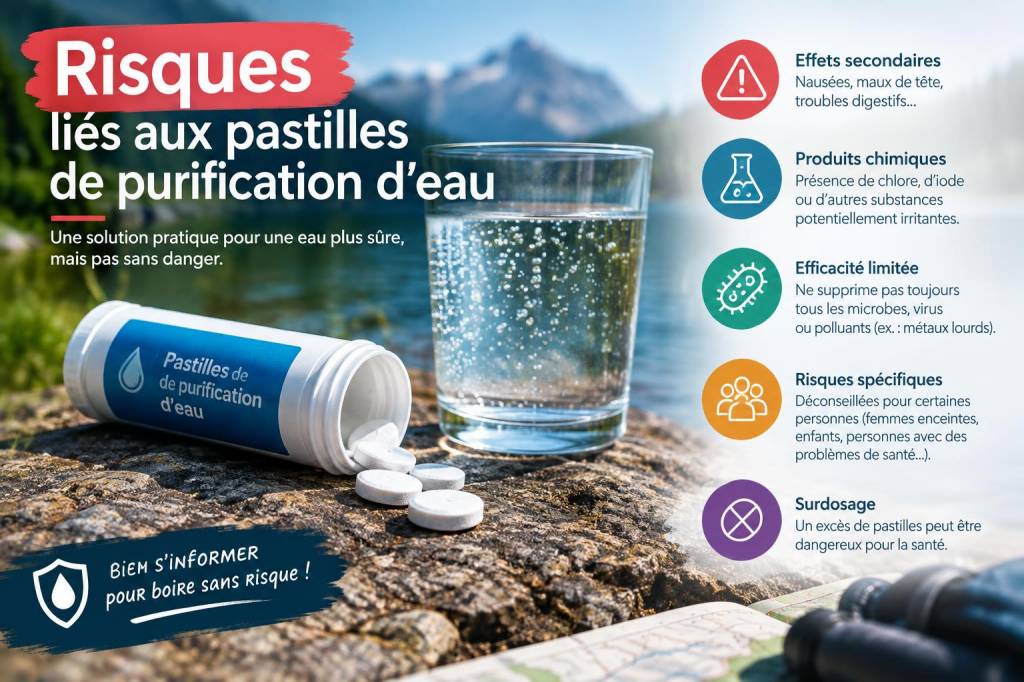
I’ve spent countless days walking windswept ridges and following streams into remote coves, and on many of those trips I’ve reached for a small, familiar foil packet: a purification tablet. They’re lightweight, easy to carry and promise safe water in a pinch. But as useful as they are, I’ve also learned to be cautious—there are real risques liés aux pastilles de purification deau that deserve attention before you pop one into your bottle.
What do I mean by “risks”?
When I talk about risks, I’m thinking of three broad categories: health risks (side effects, incomplete disinfection), practical risks (taste, effectiveness in cold or murky water), and environmental or logistic risks (chemical residues, disposal, compatibility with gear). Each matters differently depending on whether you’re on a day-hike, a week-long trek in the Highlands, or traveling in regions with poor sanitation.
How purification tablets work — and where they can fail
Most pastilles (tablet-style) water purifiers use either chlorine, chlorine dioxide, or iodine as the active agent:
- Chlorine / sodium dichloroisocyanurate (NaDCC): fast acting, widely used in products like Micropur (Katadyn). Effective against bacteria and viruses, less so against some protozoan cysts unless contact time is long.
- Chlorine dioxide: more effective against Giardia and Cryptosporidium than plain chlorine; popular for travel tablets.
- Iodine: historically common, effective against bacteria and many viruses but less reliable against Cryptosporidium and has drawbacks for long-term use (thyroid concerns, taste).
Failures happen when tablets are used outside their recommended conditions: very cold water slows chemical reaction, very turbid water shields pathogens, insufficient contact time leads to incomplete kill, and expired tablets can lose potency.
Health risks I’ve taken seriously
From personal experience and conversations with rangers and fellow trekkers, these are the health-related concerns I weigh:
- Incomplete inactivation of protozoa: Cryptosporidium can resist some chlorine-based treatments. Chlorine dioxide is better, but even then contact time and concentration matter. The CDC and WHO both note that some protozoa require filtration or boiling for reliable removal (source: CDC travel water guidance).
- Allergic reactions and sensitivities: I’ve met hikers with iodine sensitivity or thyroid issues who must avoid iodine tablets. Some people report skin irritation or digestive upset from chemical residues.
- Long-term exposure risks: Frequent, prolonged use of iodine-based tablets can affect thyroid function, especially in those with pre-existing conditions or pregnant women. The EPA and WHO provide guidance on iodine intake limits (see WHO iodine guidance).
- Chemical by-products: Chlorine reacts with organic matter to form disinfection by-products (DBPs) which at high chronic exposure are a concern in municipal water. In the field, these risks are minor compared with acute infection risk, but they’re not zero.
Practical and performance risks I’ve learned to manage
On cold Scottish lochs or silty mountain streams, I’ve tested what works—and what doesn’t:
- Slow action in cold water: At low temperatures, tablets take much longer to disinfect. Manufacturers often recommend extended wait times (e.g., up to 4 hours) for cold water—something I plan for or avoid by carrying a stove to boil when necessary.
- Turbidity reduces effectiveness: If water looks cloudy, microorganisms can hide in particles. Pre-filtering with a bandana, coffee filter or a simple micro-sieve greatly improves tablet performance.
- Taste and smell: Chlorine and iodine both add an aftertaste many find unpleasant. I keep citrus concentrate or flavor drops as a remedy, but taste can make people shy away from proper dosing, which increases infection risk.
- Compatibility with containers: Some chemicals can degrade water bottles with thin plastics over long exposure; I avoid leaving treated water in soft bottles for days.
Statistics and context — why disinfection matters
To put the risks in perspective, here are some key figures I refer to when deciding how to treat water on a trip:
- Worldwide, unsafe water contributes to around 1.4 million deaths annually from diarrheal diseases (WHO estimate).
- In backcountry and travel settings, the majority of acute gastrointestinal illnesses are caused by bacteria and viruses — pathogens that many tablets handle well if used properly.
- Protozoan infections from Cryptosporidium are less common but often cause longer-lasting illness and require filtration or boiling for reliable prevention.
These stats remind me that while tablets aren’t perfect, proper use dramatically reduces acute infection risk compared with drinking untreated water.
Environmental and disposal concerns
I care about leaving no trace. That includes how I handle chemical tablets:
- Disposal of packaging: Foil wrappers and plastic should come home with me to avoid littering fragile environments.
- Chemicals in the environment: The concentrations used to treat drinking water are low, but I avoid dumping treated water into sensitive waterways and try to neutralize or disperse residues away from springs.
- Wildlife impact: I never use chemical tablets directly at springs where animals drink; instead I walk a short distance and treat water in my container.
When tablets are not enough — alternatives and combinations I trust
Given the risks, I rarely rely solely on tablets for long trips in high-risk areas. Here’s the toolkit I’ve assembled:
- Boiling: The most fail-safe method. Bring water to a rolling boil for 1 minute (or 3 minutes above 2,000 m) — recommended by WHO and CDC.
- Mechanical filtration: A pump or gravity filter with a pore size ≤0.2–0.3 μm removes bacteria and protozoa reliably. I use filters for river water, then drop a tablet for virus protection where needed.
- UV purifiers: Portable UV pens (e.g., SteriPEN) neutralize bacteria, viruses and protozoa quickly, but they require batteries and clear water. I carry one when I need speed and light weight.
- Combined approaches: Filtration plus chemical disinfection covers most threats: the filter removes protozoa and turbidity, the tablet or UV handles viruses.
Practical comparison table — tablets vs other methods
| Method | Pros | Cons | Effective against |
|---|---|---|---|
| Tablets (chlorine/chlorine dioxide) | Lightweight, cheap, easy | Slow in cold/turbid water, taste, some protozoa resistant | Bacteria, viruses; variable for Giardia/Crypto |
| Boiling | Most reliable | Fuel-heavy, time-consuming | Bacteria, viruses, protozoa |
| Mechanical filtration | Removes sediment and protozoa | Can be heavy; viruses pass through small filters | Bacteria, protozoa (not viruses) |
| UV treatment | Fast, no taste | Needs clear water and batteries | Bacteria, viruses, protozoa |
Guidelines I follow in the field
Over time I developed a simple decision flow I use before deciding which treatment to apply:
- Is the water clear? If no → pre-filter with cloth and prefer filtration or boiling.
- Do I have time and fuel? If yes → boil.
- Am I carrying a reliable filter or UV device? If yes → use it and consider a tablet if virus risk is high.
- Any health considerations (pregnancy, thyroid issues)? Avoid iodine; use chlorine dioxide or other methods.
Regulatory and manufacturer guidance — what sources recommend
Before I trust a product, I check official guidance and product datasheets:
- CDC — travel water treatment recommendations: cdc.gov
- WHO — safe drinking-water guidelines: who.int
- Product MSDS and manufacturer instructions (e.g., Katadyn Micropur documentation and safety sheets).
Personal anecdotes and lessons learned
I remember a spring above a Scottish glen that looked crystal clear but still gave me a nasty bout of giardiasis because I underestimated the protozoan risk and relied on quick-acting tablets. Since then I’ve adopted a rule: clear water + tablet = OK for day trips; murky or unknown sources = filter or boil. That single lesson pushed me to carry a compact filter and a small stove on longer routes, and it’s saved me from more than one uncomfortable night.
FAQ (short answers I give fellow hikers)
- Are purification tablets safe? Generally yes for short-term use when the product is used as directed; be cautious with iodine if pregnant or with thyroid issues.
- Do they kill Cryptosporidium? Not reliably—use filtration or boiling for that parasite.
- How long after adding a tablet can I drink? Follow the manufacturer’s wait time: typically 30 minutes for chlorine dioxide in warm, clear water; much longer in cold or turbid water.
- Can I mix methods? Yes—filter first, then chemically disinfect for the broadest protection.
For those who want to dig deeper into product-specific risks and evidence, I recommend reading product safety data and official guidance from agencies such as the CDC, WHO, and independent reviews by outdoor gear labs. Here are useful links I consult regularly: CDC travel water guidance (cdc.gov), WHO drinking water guidelines (who.int), and manufacturer information like Katadyn’s Micropur datasheets (katadyn.com).