I spent three nights camping on Balnakeil beach last spring to find out which lightweight bivvy shelter actually works for an overnight shore camp. I wanted something minimal and fast to pitch between tides and driving wind, but still roomy enough for a sleeping mat, a bit of kit, and a camera I could grab in the night if the aurora flared. Over several trips I tested three popular lightweight options across different weather: a simple bivvy bag, a single‑person tarp shelter, and an ultralight one‑person tent. Below are my field impressions, practical pitching tips for the dunes and sand at Balnakeil, and the pros and cons that helped me decide what to pack for a coastal overnight.
Why choose a bivvy or ultralight shelter for Balnakeil?
Balnakeil is exposed—wind funnels off the sea, and weather can change fast. A full tent works, but it’s heavier and takes more time to pitch when dusk is falling. Lightweight shelters let me move quickly, keep a low profile, and leave less impact on fragile dune vegetation. But they also mean compromises: condensation, sand ingress, and stability in high winds are the main issues to manage.
The three shelters I field‑tested
- Bivvy bag: a simple waterproof shell (I tested the Rab Alpine Bivi and the Outdoor Research Helium Bivy copy). Weight: ~300–450 g.
- Tarp shelter: a small hex tarp used with trekking poles and guy lines (examples: Zpacks Hexamid or a lightweight sil‑nylon tarp 3.3 x 2.2 m). Weight: ~200–500 g for tarp plus stakes/cord.
- Ultralight one‑person tent: a single‑wall, freestanding or semi‑freestanding tent (I tested a Big Agnes Copper Spur UL copy and a Zpacks Duplex style). Weight: ~700–1000 g.
Field test conditions
My nights ranged from calm, clear evenings with bright moonlight to spring squalls with gusts over 50 km/h. Temperatures hovered between 3–9°C. I camped on sand behind the main dune ridge and also once on the stonier seaward edge to compare anchoring. I used my regular sleeping quilt, an insulated sleeping pad, and kept electronics sealed in a dry bag.
Performance: what worked and what didn’t
Bivvy bag: Fastest to use—slip in, zip up, done. In calm or light breeze it’s brilliant: minimal pack weight, low profile for the wind, and excellent drainage if the sand is damp. But condensation is the biggest drawback. Even with a small vent, moisture built up inside on colder nights, soaking my sleeping pad cover after extended use. Sand also easily gets inside when I open it to change layers or grab a headtorch.
Tarp shelter: The tarp was the most versatile. Properly set up it gives great ventilation and panoramic views (excellent for night sky photography), and it’s simple to pitch with a trekking pole and a few guylines. In heavy crosswinds it needs careful angling—if the tarp face is wrong it becomes a sail. Anchoring with good sand stakes (or buried deadman anchors) is essential. The tarp paired with a groundsheet and a small bivvy bag for warmth was my favorite combo for Balnakeil: balance of weight, comfort and airflow.
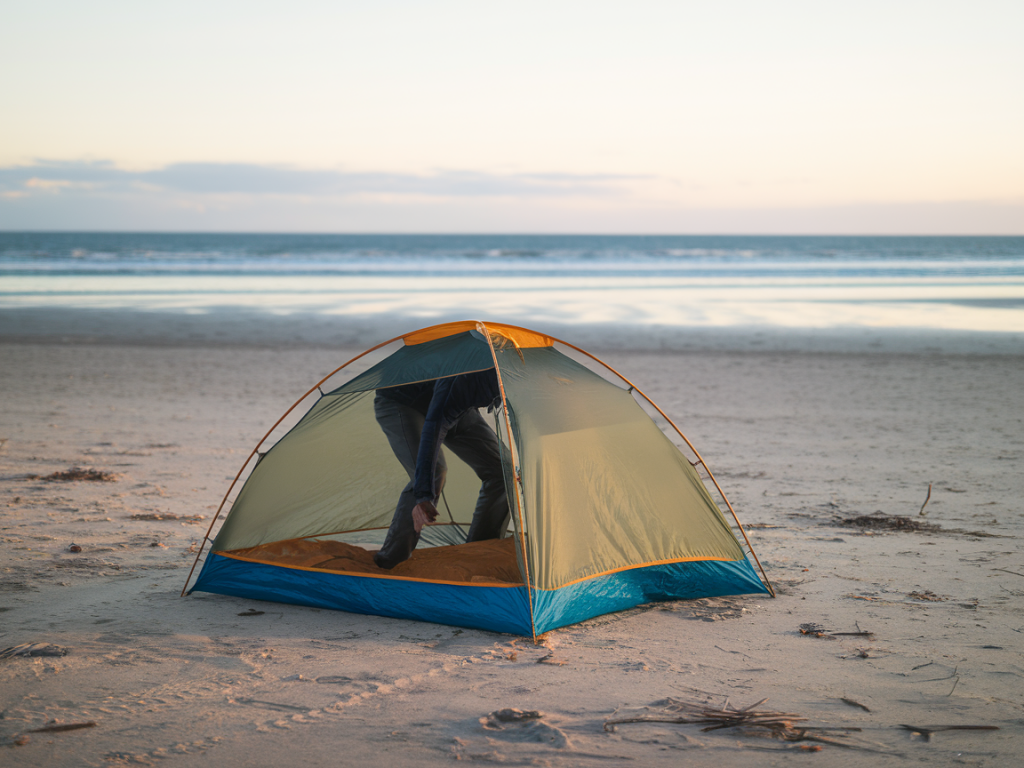
Ultralight tent: Best protection against wind and sand, with much lower condensation than a bivvy bag thanks to vents and some distance between skin and fabric. It’s heavier and takes longer to pitch, but if weather forecasts show wind or rain I choose this. The vestibule space also keeps boots and camera gear sheltered. The one downside is the higher visual impact on the dunes—I always look for existing clear areas to pitch so I’m not trampling vegetation.
Practical pitching tips for Balnakeil sand and wind
- Find the lee: look for wind shadows behind the main dune ridge or large driftwood logs. Even a small dune lip reduces gusts significantly.
- Use deadman anchors in sand: bury a stuff sack or a flat piece of driftwood crosswise about 20–30 cm deep, fill with sand and attach guyline to it. Traditional tent pegs will pull out here.
- Angle your shelter: face the lowest profile into prevailing wind. A tarp’s long axis should be parallel to the coastline with one end slightly downwind to reduce flapping.
- Lower the center of gravity: for tarps and tents, pitch lower than normal—shorter guyline lengths and smaller apex height reduce wind surface area.
- Minimise sand entry: use a small groundsheet the size of your sleeping pad, stash boots in a dry bag or in the vestibule, and sweep out sand before sleep. A lightweight bivvy with an integrated skirt helps too.
- Condensation management: use small vents, open a zipper slightly if it’s not raining, and avoid breathing directly onto shelter fabric. In bivvies, a small mesh window or unzipped foot section helps ventilate moisture.
- Set up while light: practice quick pitch in daylight; high wind at dusk is harder. If alone, pre‑position pegs/stakes so you can bury deadman anchors quickly.
Gear list I took and recommend
- Ultralight sleeping pad (R-value >3 if early spring).
- Lightweight sleeping quilt or insulated sleeping bag.
- Small footprint groundsheet (sil‑nylon) sized to pad.
- Three good length guy lines with reflective bits.
- Sand stakes / foldable pegs + spare cord for deadman anchors.
- Small tarp (3.3 x 2.2 m) or lightweight single‑wall tent depending on forecast.
- Dry bag for camera and electronics.
Quick comparison table
| Shelter | Weight (typ.) | Wind/sand protection | Ventilation / condensation | Ease of pitch | Best use at Balnakeil |
|---|---|---|---|---|---|
| Bivvy bag | 300–450 g | Low | Poor (high condensation) | Very easy | Short calm overnight; minimal pack |
| Tarp + bivvy | 400–800 g | Medium (if well angled) | Good | Moderate | Best balance of weight, views and comfort |
| Ultralight tent | 700–1000 g | High | Good | Moderate to slow | Windy or rainy nights; full protection |
Final practical advice from my nights on the sand
If I must pick one single approach for Balnakeil overnighting, it’s the tarp + bivvy combo. The tarp gives me space, control over wind direction, and a dry vestibule when set low; the bivvy provides warmth and secondary protection. If the forecast shows strong winds or heavy rain, I bring the ultralight tent. If I’m ultra‑light and conditions are calm, a bivvy bag alone is tempting—but I plan for condensation and keep electronics well‑protected.
Above all, respect the dunes: avoid nesting birds and vegetation, follow access routes, and leave no trace. With the right anchors, a careful pitch and a little practice, a coastal bivvy at Balnakeil can be one of the most rewarding ways to wake up to the sea—and occasionally, a spectacular sunrise or Northern Lights when conditions align.