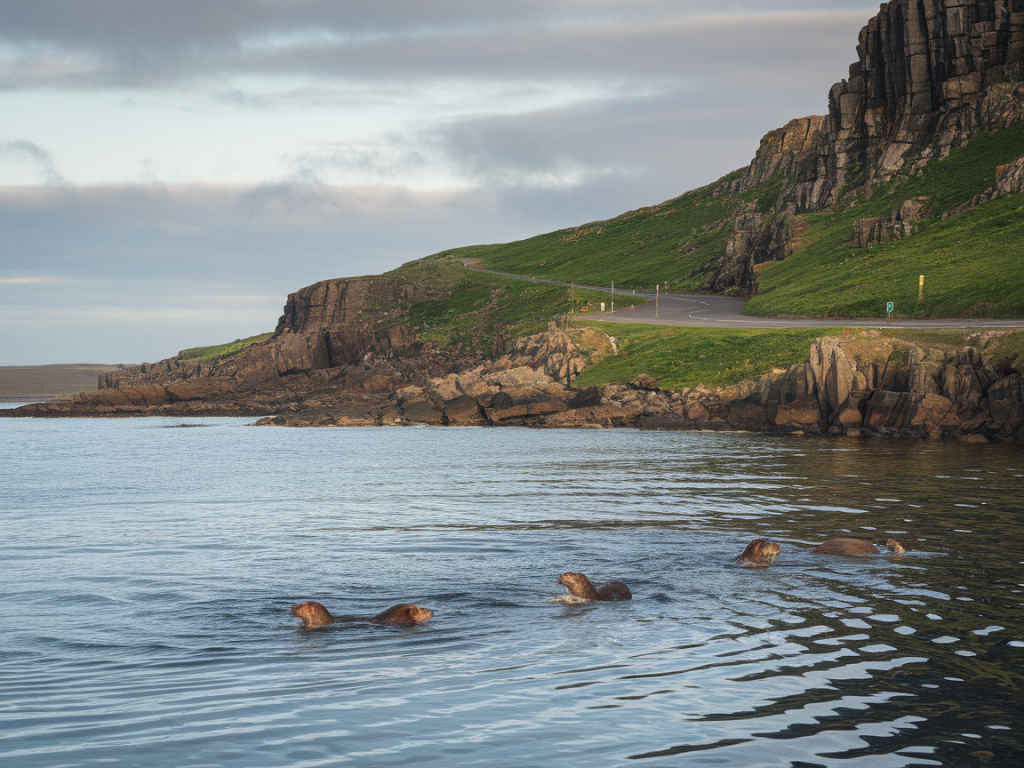
I often get asked which short coastal loop between Camel Haugh and Balnakeil gives the best chance of seeing otters. After countless mornings with binoculars fogged from my breath and camera shutters clicking, I can say there’s a clear favourite—an easy, roughly 3.5–4 km loop that starts at the Camel Haugh car park, follows the shoreline toward Balnakeil, then returns over the dunes and crofting ground. It’s short, sweet, and timed right it can be magical for otter encounters.
Why this loop?
Otters here favour the intertidal flats, rocky skerries and sheltered inlets between Camel Haugh and Balnakeil. The loop’s mix of exposed shore, rocky pools and quieter back channels gives them feeding spots and places to haul out. The route is close to Durness but feels remote, and because it’s walkable without scrambling it attracts fewer loud groups—exactly the low-disturbance setting otters prefer.
Quick facts
| Distance | 3.5–4 km (loop) |
| Time | 1.5–2.5 hours (with stops for wildlife) |
| Difficulty | Easy to moderate — mostly clear paths and sandy dunes, one short rocky stretch |
| Best time for otters | Early morning or late evening, especially at low to mid tide; autumn and winter have higher visibility for feeding behaviour |
| Access | Start at Camel Haugh car park (small, roadside); return via Balnakeil dunes or the crofting track |
Route description (step-by-step but relaxed)
I start at the small parking layby at Camel Haugh. From there, head west along the shore—keep close to the low cliffs where rock pools form. The first 1 km is sandy with patches of heather and occasional shell-littered bedrock. Look for small channels and swim-outs where otters hunt for crabs and fish.
After the initial stretch you reach a scattering of boulders and a little tidal inlet often rich with seaweed. This is a hotspot: watch quietly from the lee of the rocks or the edge of the dunes. If you see gulls hovering or frequent dives close to the shore, that often indicates a feeding otter nearby.
Continue to Balnakeil—there’s a grassy spit and a broader beach. Instead of walking straight along the sand, cut in slightly toward the dunes to follow the quieter crofting margin. From here you can see across the bay to the skerries and reef-lines where otters feed at low tide.
To return, take the dune path that runs behind the beach and follow the crofting track back toward Camel Haugh. This return offers different vantage points into the intertidal pools and often a better view of any otters moving along the high-tide line.
Best time of day and tide advice
Otters are crepuscular—most active at dawn and dusk—so aim for just before or after sunrise and again near sunset. Tidal timing is crucial: plan to be on the shore from high water to the mid-ebb for the best feeding activity as fish and crustaceans get exposed or more concentrated in pools.
Check the Hebridean tide tables or the UK Admiralty planner. If you’re photographing, the golden hour light at low tide can be spectacular on the wet rocks and seaweed—but it’s also when otters are busiest, so stay still and quiet.
How to maximise your chance of a sighting
- Arrive quietly and keep noise to a minimum. Otters are easily spooked by sudden movements and loud voices.
- Use binoculars (I use a lightweight pair from Swarovski or Vortex) and a zoom lens on your camera rather than trying to approach close.
- Position yourself behind a natural screen—dunes, rocks or low vegetation help conceal you.
- Look for signs: spraint (otter droppings) on rocks or posts near tide lines, slide marks on grassy banks, or fish bones near haul-out spots.
- Patience pays. Bring a thermos and settle in—otters can be watchable for long stretches once they’re comfortable with your presence.
What to pack
- Binoculars (8x or 10x)
- Camera with telephoto lens (200–400mm preferred) or a good bridge camera
- Warm, waterproof layers and windproof jacket—coastal winds bite
- Sturdy waterproof boots for rocks and damp dunes
- Small stool or sit mat if you plan to stay still
- Thermos and snacks
- Plastic bag for any litter—leave no trace
Ethics and wildlife etiquette
Otters are protected and easily distressed. I never approach a seen otter, chase it, or block its route to the water. If an otter shows signs of agitation—hurrying into water or keeping low—give it space. Keep dogs on leads and, ideally, away from otter-rich sections of shore. Disturbance during breeding season (usually late spring to early summer) can have severe consequences.
Report any injured or distressed wildlife to the local ranger or Scottish SPCA, but don’t attempt to handle wild animals yourself.
Photo tips
Autofocus can struggle on low contrast subjects like wet rocks and dark fur—switch to single-point AF and use continuous shooting if the otter is moving. A monopod helps when using heavy lenses. For composition, include a bit of the shoreline or a standout rock to give scale; otters look tiny on open water.
Seasonal notes
Winter and autumn often offer the best feeding displays because otters are hunting more actively and the light quality is dramatic. In spring you may catch family groups—adults with pups—but be especially careful not to disturb them near holts (their dens). Summer brings long daylight hours and easier walking, but also more visitors, so early starts are still the best bet.
Transport, food and practicalities
Camel Haugh is a short drive from Durness village; there’s limited parking so arrive early in summer. If you’re staying in Durness, a bike can be a pleasant way to reach the start without worrying about parking. After the walk, Balnakeil cafe (seasonal hours) and the Durness shops are good for tea and a warming snack—support local when you can. If you prefer to pack a lunch, the dunes make a glorious spot to eat at a respectful distance from wildlife.
Local observations I've made
One clear memory: dawn on a crisp late-October morning when a single otter worked the pools near Camel Haugh for over 20 minutes, surfacing with a wriggling crab, then rolling on a sun-warmed rock to eat. Small moments like that—quiet, unhurried, and shared with the sea—are why I keep returning. If you plan this loop with patience and respect, there’s a very good chance you’ll have a similarly intimate encounter.