I first learned how fragile a great puffin photo can be when I trod too close to a burrow and watched an adult bird hesitate at the entrance, clearly unnerved. That moment changed how I approach seabird colonies: close-range images are possible, yes—but only when you prioritise the birds’ welfare over the shot. Below I share practical tips I use when photographing Atlantic puffins around Durness and other Scottish colonies, whether I’m shooting with a phone or a 70–200mm lens. These techniques help you get intimate frames while keeping nesting birds safe and undisturbed.
Know the birds and the season
Puffins are seasonal at most UK colonies, generally arriving in spring and leaving late summer. They nest in burrows on grassy clifftops and often return to the same burrow each year. During the breeding season they are focused on feeding chicks, so disturbance can cause abandonment or missed feeds. I always check local guidance from rangers or crofters before planning a session—some sites have restricted access or recommended viewpoints for a reason.
Ethics and legal considerations
In the UK puffins are protected under wildlife laws that make deliberate disturbance an offence in certain contexts. Beyond legalities, follow these simple rules I never break:
- Keep your distance: use long lenses or optical zoom on phones; don’t try to approach a burrow.
- No baiting: never throw food to lure birds closer.
- No flash: sudden light can disorient adults and chicks.
- Give them an escape route: don’t block flight paths or stand between sea and burrow entrances.
- Follow local rules: respect roped-off areas and rangers’ instructions.
Approach and hide techniques
Puffins are tolerant to people who stay still and quiet. My favourite approaches are slow and low:
- Arrive early or late in the day to avoid crowds and strong midday wind that flattens their flight patterns.
- Wear muted clothing—greens, browns, greys—and avoid shiny gear. A light windproof overlayer is useful on clifftops.
- Use natural cover: lie behind tussocks or low drystone walls. I sometimes sit on a small, foldable stool to steady my height and remain still for long periods.
- When possible, use a portable hide or a lightweight camouflage blanket draped over a low stool—only if allowed at the site and used well back from burrows.
- Let birds acclimatise to your presence: sit and wait. If birds show signs of stress (frozen posture, repeated alarm calls, adults staying away from burrows), move farther away.
Phone photography: getting close without getting close
Modern phones are surprisingly capable. I use an iPhone or a recent Android and a few accessories when I want a close, detailed puffin shot:
- Optical zoom or clip-on lens: Prefer phones with a true telephoto lens (2–3x optical). If yours lacks optical reach, a quality clip-on tele (Moment, Olloclip) helps more than digital zoom.
- Stabilisation: a compact tripod or a GorillaPod keeps images sharp. Phones with sensor-shift stabilisation help with slower shutter speeds in low light.
- Settings: lock exposure and focus (AE/AF lock), use burst mode for action, and shoot in RAW if your phone supports it (Apple ProRAW or Android RAW).
- Remote shutter: use a Bluetooth remote or the volume button on wired earphones to avoid bumping the phone.
- Composition: get low, keep a clean background (sea or sky), and aim to capture the puffin’s eyes sharply.
70–200mm lens: my go-to for cliff-edge portraits
The 70–200mm is one of the most versatile lenses for puffins: at longer focal lengths it lets you fill the frame from a respectful distance. I usually pair it with a full-frame body, but crop-sensor cameras work well too.
- Which 70–200? Both f/2.8 and f/4 versions are great. f/2.8 gives better low-light performance and subject isolation; f/4 is lighter for long walks. Brands: Canon, Nikon, Sony, Sigma and Tamron all make excellent versions.
- Distance estimations: on a full-frame camera at 200mm, you can comfortably fill-frame a puffin from roughly 8–25 metres depending on your framing. On a 1.5x crop body you’re effectively at 300mm reach.
- Aperture and depth of field: around f/4–f/6.3 gives a pleasing background blur while keeping both eyes and the beak in focus.
- Shutter speed: for perched birds 1/800s is safe in wind; for flight or landing shots push to 1/1200–1/2000s. Use higher ISO if needed—modern sensors handle ISO 800–3200 well.
| Camera / Phone | Typical Settings |
| Phone (with tele) | Pro/RAW, AE/AF lock, burst, tripod, no flash |
| 70–200mm (sits) | 200mm, f/4–6.3, 1/800–1/1200s, ISO 200–1600, AF-C |
| 70–200mm (flight) | 200mm, f/4, 1/1600–1/2000s, ISO 400–3200, continuous AF, burst |
Focus, composition and timing
I prioritise the eyes. Use single-point AF on a 70–200 and place it over the eye; on phones tap the eye to focus. For landing or flight I switch to continuous AF and track the bird with back-button focus if my camera allows it. Burst mode is indispensable—many great frames come from a short sequence.
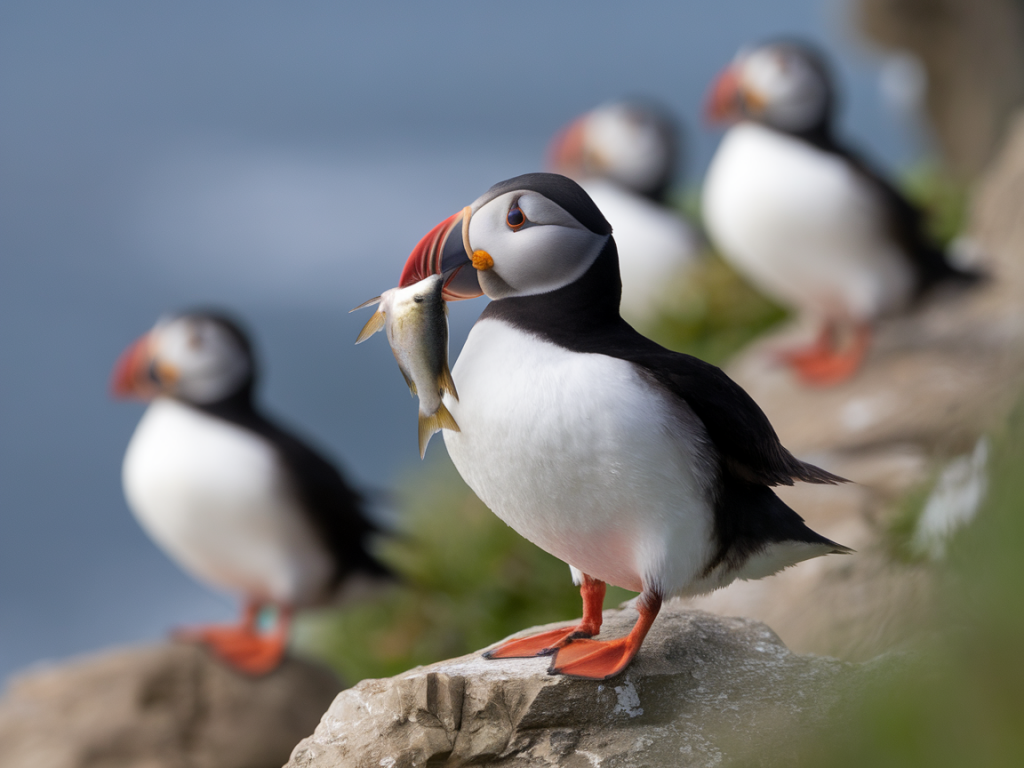
For more evocative shots, look for behaviours: incoming adults with beaks full of sand eels, bill-to-bill exchanges, or a chick’s head peeking from a burrow. Low light at golden hour warms their bill colours—plan sessions around sunrise or sunset when safe and allowed.
Post-processing tips
Shoot RAW when you can. I gently lift shadows, protect highlights, and ensure the orange on the bill and feet look natural. On phones, apps like Lightroom Mobile or Snapseed give powerful controls. Don’t over-sharpen—feathers look better with natural texture, not haloed edges.
Common questions I get asked
- How close is safe? There’s no fixed number—habitat, burrow density, and local rules matter. If birds change behaviour as you approach, you’re too close. I usually keep at least 10–20 metres and rely on 200mm reach; more if the site feels sensitive.
- Can I use a hide? Yes, if allowed and used responsibly well back from burrows. Never place a hide across known flight routes or within rope lines.
- Is it better to crop? Crop conservatively. If your subject is small in-frame but the bird shows no stress, cropping is preferable to moving closer.
Photographing puffins closely is a balance of patience, optics, and restraint. Keep the birds’ needs first, and you’ll find that the best images come from observation, slow approach, and respect for the cliff-edge world they call home.